Hands that shape light: reading enamel and guilloché dials
Understand enamel techniques, hand engine-turning and the different roles of stamping and printing, then build a practical notebook for observing a dial.
Understand enamel techniques, hand engine-turning and the different roles of stamping and printing, then build a practical notebook for observing a dial.
Read the different kinds of work on one dial
Light reaches us before terminology does. Fine lines appear and disappear as a dial turns; two white surfaces can seem to have different depths. Understanding enamel and guilloché makes it easier to ask what produced those impressions. This is a guide to observation rather than a hierarchy of prestige. Separate the material, the method used to shape its surface and the information added on top.
If a retailer says enamel, ask whether that describes the entire dial or only one part. If the word guilloché appears, ask which tool and process it identifies. A lustrous surface alone cannot prove its method of production. Link the exact reference to its technical description, then record your visual response separately. Respect for craftsmanship begins with accurate questions, not simply with a longer vocabulary.
Enamel: colour shaped by firing
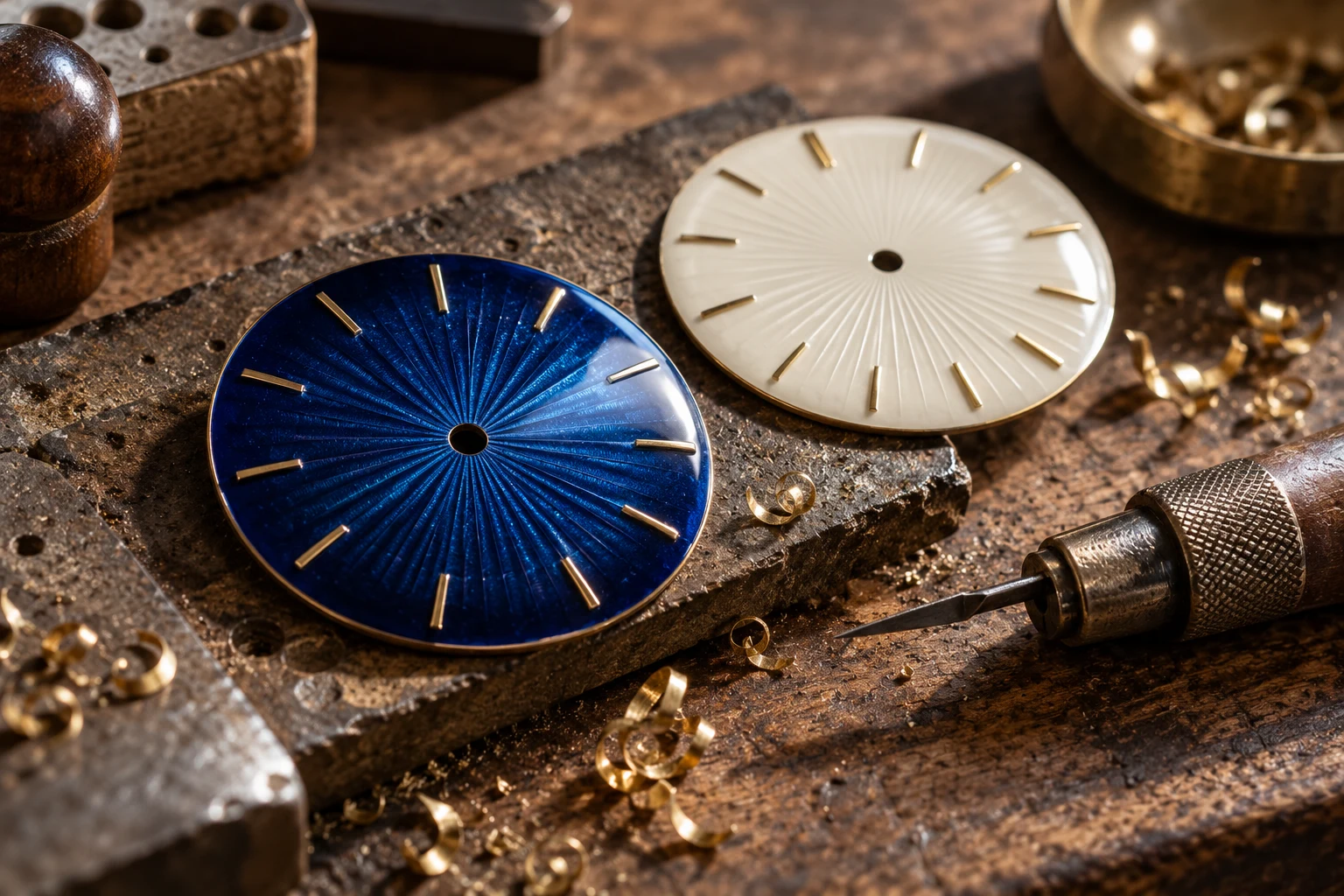
Vitreous enamel involves fusing a glass-like material to a metal base. anOrdain illustrates the application and firing of successive layers, while Breguet describes the judgement required to anticipate colour changes and distortion during Grand Feu work. A documented firing process distinguishes the craft from a general impression of shine or whiteness. Neither a glossy finish nor a particular colour establishes that a dial is enamel. [1][4]
Grand Feu does not name one colour or pictorial style. Opaque fields, transparent layers and small painted scenes can involve different approaches, so read the process alongside the finished surface. Do not transfer one workshop’s firing temperature or production time to another maker. A documented number of firings belongs to the particular object. It can explain work, but it cannot assign a score to your personal enjoyment.
Cloisonné and champlevé build boundaries differently
Cloisonné uses fine wire to form compartments for enamel; champlevé fills recesses cut into the metal base. Patek Philippe’s craft account distinguishes both from miniature painting on enamel. A map or flower motif does not establish which technique was used. Ask how the boundaries and base were made, and whether several methods appear together in the same small picture. [2]
Look at the whole picture first, then follow one boundary: a coastline, a petal or the hands crossing above it. Magnification and normal viewing distance answer different questions. You may admire the precision in a close-up yet find the image too small, or the time difficult to read, when wearing it. That response is useful rather than unsophisticated. Craft achievement and personal usability can be considered together.
Guilloché: a machine can still require an artisan
Traditional hand-executed guilloché uses manually controlled machinery to cut repeating geometric decoration. Patek Philippe’s technique notes explain that relationship; Breguet also connects its decoration with managing reflections and separating indications. The presence of a machine does not remove the artisan from the process. A better question is who controls what, and how the surface is actually produced. [1][3]
Turn the dial gently and compare the centre with the perimeter as the reflection changes. Notice whether patterns organise separate indications. Finding an irregularity under a loupe is not proof of handwork. Use manufacturing documentation to establish the process, and use your eyes to assess proportion, rhythm and changing light. Appreciation and authentication require different kinds of evidence; neither improves when the two are confused.
Flinqué: colour over engraved pattern
Flinqué enamel combines an engraved guilloché surface with translucent enamel through which the pattern remains visible. Patek Philippe’s 2024 Rare Handcrafts dossier defines the combination. Its The Pink Bay reference 5077/100G-082 is a documented example bringing together guilloché, flinqué, cloisonné and miniature painting. Several craft terms can therefore describe different contributions to one dial, rather than competing descriptions of the same task. [3][5]
Try observing the repeating ground first, then the colour and finally the drawn contours. You need not identify every layer immediately; discover which part attracts you. Preferring a plain dial does not mean failing to appreciate the more elaborate object. A complex image and a restrained field invite different kinds of attention. Greater knowledge should make your choice clearer, not oblige you to choose the busiest surface.
Read stamping and printing without shortcuts
Production is often a sequence of different processes. anOrdain documents stamped silver bases for its fumé work and pad-printed dial markings after enamelling. Forming a base, creating a coloured surface and adding numerals need not use the same method. The isolated words stamped or printed therefore cannot describe the entire dial or settle its artistic value. Read the sequence as a whole. [4]
Equally, a description of a guilloché pattern alone does not establish hand engine-turning. Request a process description if the wording is unclear. A pattern may still appeal even when the production method is not documented; simply record only what you can establish. Enjoying an object and later representing its manufacture to someone else carry different responsibilities. Accuracy allows both pleasure and honest description.
Do not romanticise every irregularity
Individual character is appealing, but an intended variation and damage are not interchangeable. If you notice a mark, compare it with the condition description rather than immediately calling it an artisan’s signature. For a new watch, ask about inspection criteria; for an older one, request previous photographs and service records. When a photograph cannot explain a line or its severity, seek examination of the actual object.
Before restoration or replacement, request a written description of the available work and what will change. Owners may place different priorities on preserving an original surface and returning a watch to usable condition. Keep those choices distinct and retain the resulting records. Rarity does not oblige you to accept uncertainty about care. For an object intended to remain with you, the maintenance explanation belongs beside the craft explanation.
Follow the sequence in workshop photographs
In workshop photographs, look for the starting base and intermediate states as well as the finished object. Identify the sequence: working the metal, adding colour and applying markings. Connect the photographed reference to the watch under discussion where possible. A scene in a general brand film does not establish how every reference is made. Record only the connection the material actually supports.
If a workshop visit becomes possible, ask which stages can actually be observed. Follow guidance before touching tools or moving work, and respect the workshop’s time and photography conditions. Afterwards, distinguish what you saw from what was explained. That separation produces a more accurate account and helps you recognise, on the next encounter with a similar dial, what you know and what remains a question.
A short notebook for looking closely
Use four spaces in a notebook: documented material and process, colour and contrast in ordinary light, readability on the wrist, and questions about care. Keep official description separate from personal impression. Recording Grand Feu as a documented fact and a warmer appearance near a window as an observation makes later comparisons more useful. You preserve both kinds of information without asking either to prove the other.
Craft terminology should help you look for longer. Instead of collecting the greatest number of techniques, discover what you enjoy in one surface: a boundary, a repeating line, colour over relief or an uninterrupted white field. A notebook remains useful even when no purchase follows. At the next exhibition or boutique, you will have better questions. The pleasure of understanding can grow independently of ownership.
Sources and editorial note
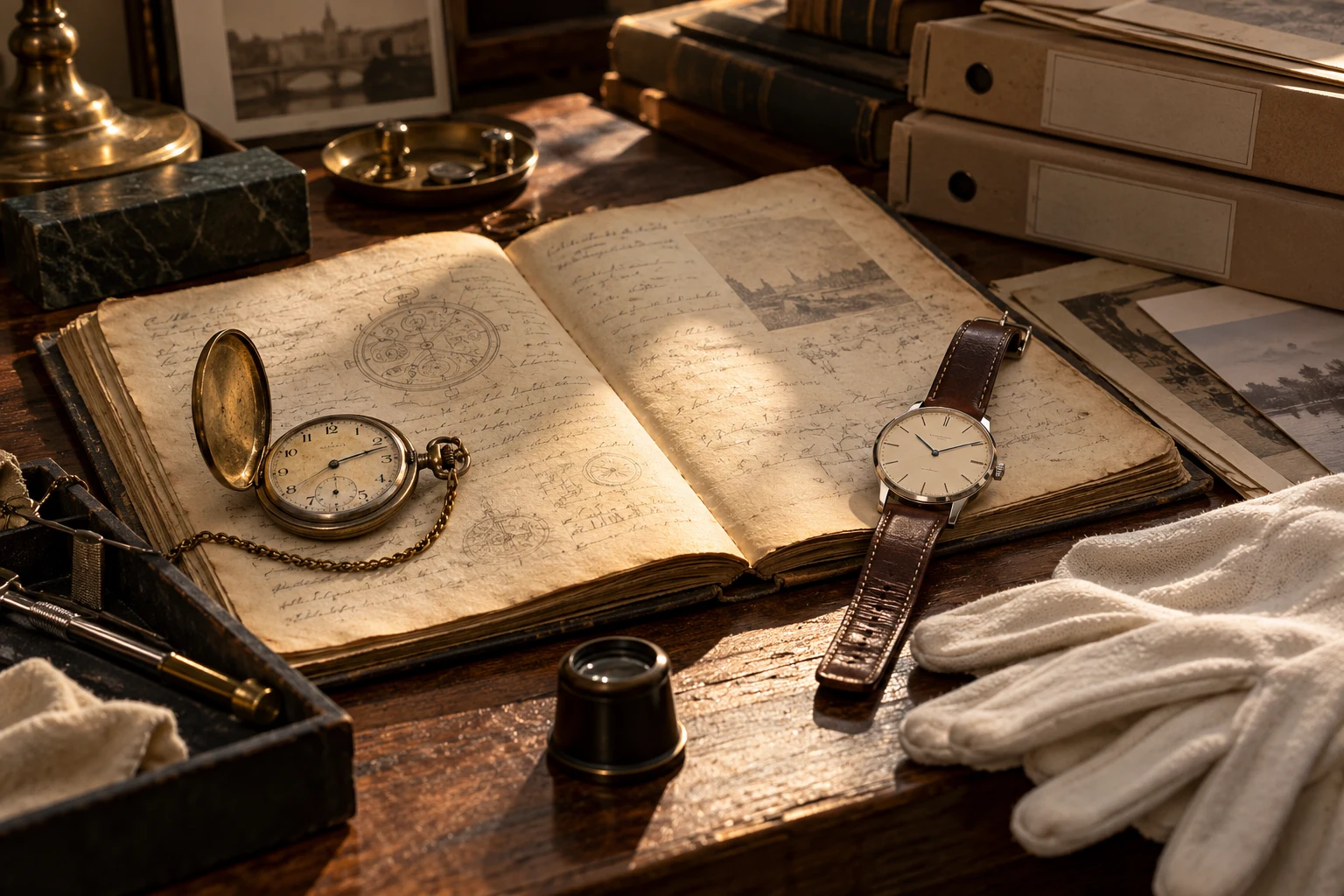
The cover is an AI-generated editorial illustration. It is not a documentary photograph of a particular place, product or person discussed in this article.
Sources checked on 1 November 2026. This craft commentary compares public manufacturer and workshop documentation. It is not an account of a workshop visit or an authentication report. Verify processes, production details and service options for the exact reference.
[1] Breguet — Craftsmanship and watch decorations · View source: www.breguet.com
[2] Patek Philippe — The art of enameling · View source: www.patek.com
[3] Patek Philippe — Rare Handcrafts 2024 press dossier · View source: static.patek.com
[4] anOrdain — Enamel · View source: anordain.com
[5] Patek Philippe — The Pink Bay, Ref. 5077/100G-082 · View source: www.patek.com