Watches in the ledger: what brand archives reveal and leave open
Explore Longines serial records, gaps in the history of Breguet No. 160 and the Reverso patent, then distinguish an archive extract from present-day authentication.
Explore Longines serial records, gaps in the history of Breguet No. 160 and the Reverso patent, then distinguish an archive extract from present-day authentication.
The question after “old”
A vintage watch story often begins with a year: a 1930s design, a discontinued movement or initials left by an earlier owner. Archives offer more than an elegant way to say old. They ask who made a record, why it was made and what it can actually establish. A sales ledger, patent application and repair entry all concern the past, but they answer different questions.
We begin with three scenes from manufacturers’ published records, then connect them to investigating an individual watch. Accuracy need not eliminate every legend, but documentation does not validate every legend either. Keeping both evidence and gaps visible makes history more interesting. The rewarding part is a traceable route from a claim to its supporting record, not merely a dramatic conclusion at the end.
Longines: a serial number opens a ledger
Longines states that it has preserved historical information linked to the serial numbers of its watches since 1867. The interesting point is the connection between a particular object and a record, rather than the impressive age alone. Many watches may share a model name, but a serial number narrows the enquiry. Its service page also distinguishes an archive extract from an authentication certificate involving a watchmaker’s examination. [1]
The practical lesson is to record identifiers carefully before collecting anecdotes. Establish where the reference, case number and movement number are located, without opening a case yourself merely to see them. Request the necessary examination from an appropriate service provider. Keep research details separate from public photographs rather than casually exposing complete identifiers online. A well-organised enquiry begins with knowing exactly which object you are discussing.
Breguet No. 160: a gap can be part of the story
Breguet’s account of the Marie-Antoinette watch No. 160 makes its gaps visible. It records completion in 1827, no surviving sale entry, absence from an 1833 inventory and an 1838 repair entry involving the Marquis de La Groye. The timing and terms of the transfer remain unresolved. Even a manufacturer’s own historical narrative can identify questions its records do not answer. [2]
A name in a repair book and a documented purchase are different kinds of evidence. Imagination can make a missing period easier to narrate, but harder to verify. Apply that distinction when a seller offers an earlier owner’s story. Ask whether a document exists, whether it identifies this watch and whether it records ownership, a repair request or something else. The strength of the claim should match the strength of the connection.
Reverso: reading a reversible case through documents
Jaeger-LeCoultre links the Reverso to protecting a watch during polo and traces a patent application on 4 March 1931, followed by rights transfer and registration of the name. The design passed through invention, commercialisation and naming rather than arriving fully formed as an icon. Looking at the rectangular silhouette becomes more rewarding when you also consider the problem the reversible construction was intended to address. [3]
The birth year of a design is not the production year of every object carrying its name. A collection originating in 1931 can include much later examples, revivals and reinterpretations. In an exhibition, record the date of the design, the date assigned to the individual exhibit and any modern reference separately. This small habit turns a familiar silhouette into a more precise historical observation.
Different documents answer different questions
Patek Philippe describes its Extract from the Archives as a partial transcription of historical records and distinguishes it from the Certificate of Origin supplied with a new watch. Jaeger-LeCoultre explicitly says that an archive extract does not assess present condition and is not an authenticity certificate. Read the document’s stated purpose rather than treating the maker’s name on the cover as a universal guarantee. [4][5]
Divide a research file into three questions: what do historical records say, what are the watch’s present components and condition, and which documents connect ownership, sale and service? One document need not answer all three. Leave a question open when evidence is missing. If considering a purchase, discuss the required scope of examination and written conditions with the seller and service provider before treating the file as complete.
Current condition needs its own evidence
When combining archive research with condition assessment, distinguish original specification, present condition and changes made during service. Ask about dial, hands, case and bracelet without automatically sorting every replacement into good or bad. It may have been necessary for use, or may matter greatly to an owner focused on preservation. Stating your priorities first makes a service discussion more concrete and less dependent on assumptions.
Store photographs against a dated condition description rather than relying on one attractive frontal view. Separate before-service and after-service records. Avoid deciding polishing history or component age from an impression alone; ask an examiner to identify what is established and what remains uncertain. A good record does not promise to eliminate every question. It tells the next person exactly where the questions are.
Follow one change through an exhibition
Trying to memorise every timeline can exhaust a museum visit. Follow one question instead: how date displays changed, what decoration a reversible case permitted, or how travel information appeared on a dial. Tracing that question across makers and periods broadens the experience from admiration of an expensive object to understanding a changing design problem. You can leave with a useful observation without remembering every reference number.
Preserve distinctions between a dated object, an estimated date and an interpretation supplied by the exhibiting institution. Record catalogue numbers and pages when available. Follow the venue’s photography rules, and do not fill an unreadable label from memory. Keep it as a question for later. Afterwards, choose the watch that made you most curious, rather than the most expensive exhibit, and read further about it.
Build a one-page object record
Put model identifiers, purchase documents, official links and verified service history on the first page of a personal file. Follow with dated photographs and correspondence. Mark documented facts, the seller’s account and your own inferences differently so that another reader can follow them. Preserve the date and organisation behind an email response. An unsourced online description belongs in a separate reference note, not among established facts.
An orderly file does not guarantee a future price or an easy sale. It does let you pass on what is known and what remains unknown. That clarity helps with a gift or a later transfer. If the watch may stay in a family, record why you chose it as well as its historical date. A manufacturer’s old ledger and your own brief note are different records, but both give the next person a place to begin.
The pleasure lies in how you handle the gaps
Even official material deserves attention to genre. A corporate history is a story selected for an audience; a numbered ledger or patent was created for a particular administrative purpose. They can complement one another without becoming substitutes. Enjoying the narrative while identifying its evidence helps you recognise the distance between promotion and historical research. Respect for records and careful questioning can work together.
The first question becomes simple: what can currently be established about this object? The next is equally useful: what would I like to learn? The space between them can sustain the pleasure of collecting. Leave an unverified anecdote unfinished and remain willing to revise a note when evidence appears. An archive preserves a past, but reading it carefully is also a present-day habit of looking honestly at things.
Sources and editorial note
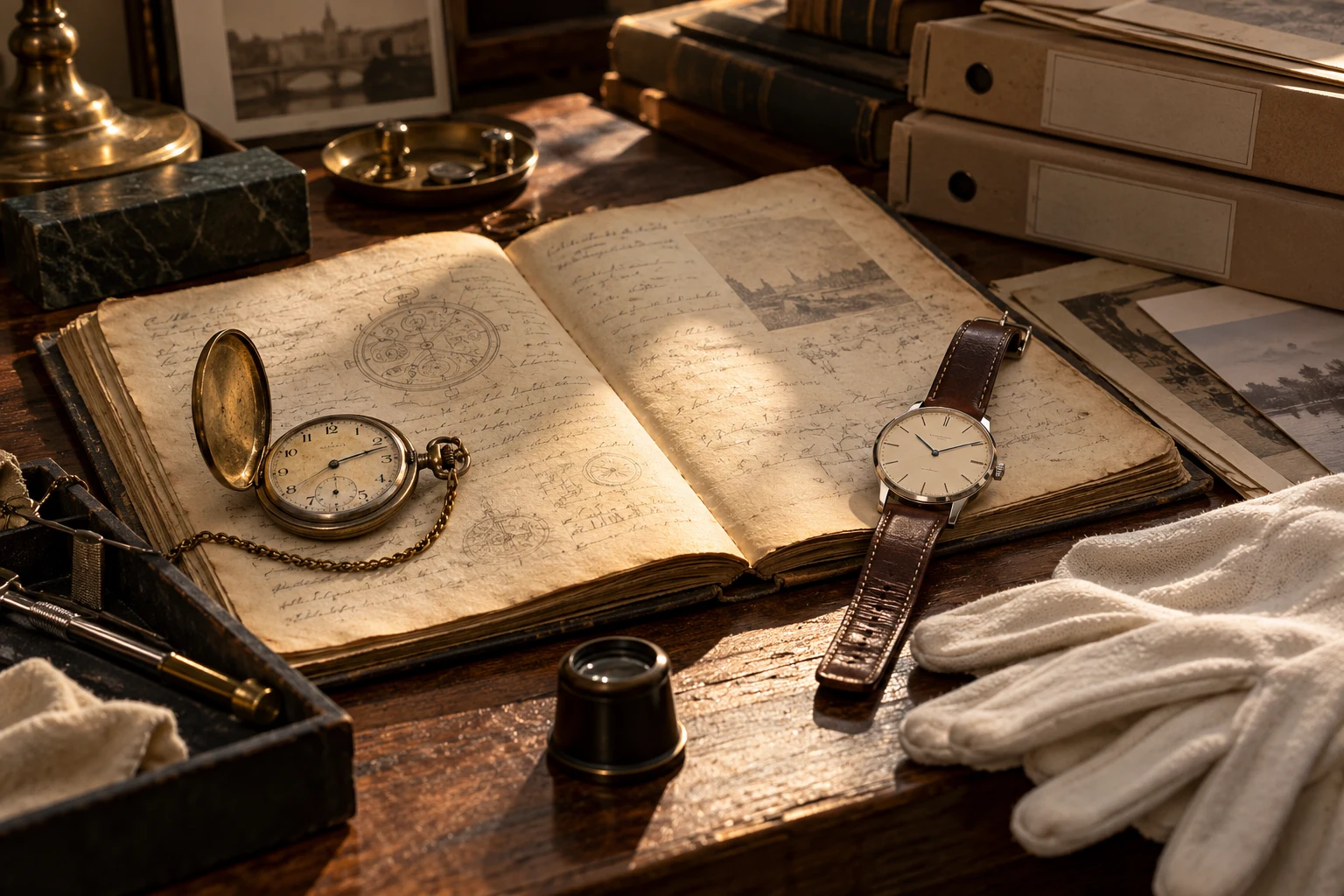
The cover is an AI-generated editorial illustration. It is not a documentary photograph of a particular place, product or person discussed in this article.
Sources checked on 1 November 2026. This historical essay reads public brand records, timelines and service explanations. It is not an assessment of an individual watch’s authenticity, condition or value. Recheck current archive-service terms when enquiring.
[1] LONGINES — History of my watch · View source: www.longines.com
[2] Breguet — The Marie-Antoinette watch No. 160 · View source: www.breguet.com
[3] Jaeger-LeCoultre — The history of the Reverso · View source: www.jaeger-lecoultre.com
[4] Patek Philippe — Extract from the Archives FAQ · View source: www.patek.com
[5] Jaeger-LeCoultre — Extract from archives · View source: www.jaeger-lecoultre.com