The collector’s eye: learning to look before owning
Begin with the Vogels, then build an observation notebook, relationships between works and a practical system of care. A collection starts taking shape before the first invoice.
Begin with the Vogels, then build an observation notebook, relationships between works and a practical system of care. A collection starts taking shape before the first invoice.
A large question in a small home
The National Gallery of Art’s account of Herbert and Dorothy Vogel offers an accessible starting point. A postal clerk and a librarian, they collected conceptual and minimalist art and developed sustained relationships with artists. Their story invites attention to the time spent looking and talking, beyond the eventual prominence of their holdings.[1]
This is no repeatable formula for financial success. The useful inheritance is a sequence of questions: what kept their attention, what changed after a conversation, and what remained in mind at home? A collection begins to acquire a point of view during those apparently unproductive intervals, before any object changes hands.
Give the first response a sentence
When something catches you, identify the precise interruption: an empty area at the bottom, a scratched line, or a colour that becomes legible only at a distance. “Beautiful” can be a beginning, but a more exact sentence gives you something to compare when another work also feels compelling.
Try three notebook columns: what is visible, what it brings to mind, and what remains unknown. Repeated grey lines are an observation; a memory of a rainy street is your association. Keeping the two separate allows a personal response without quietly turning that response into an invented account of the artist’s intentions.
Comparison makes a preference clearer
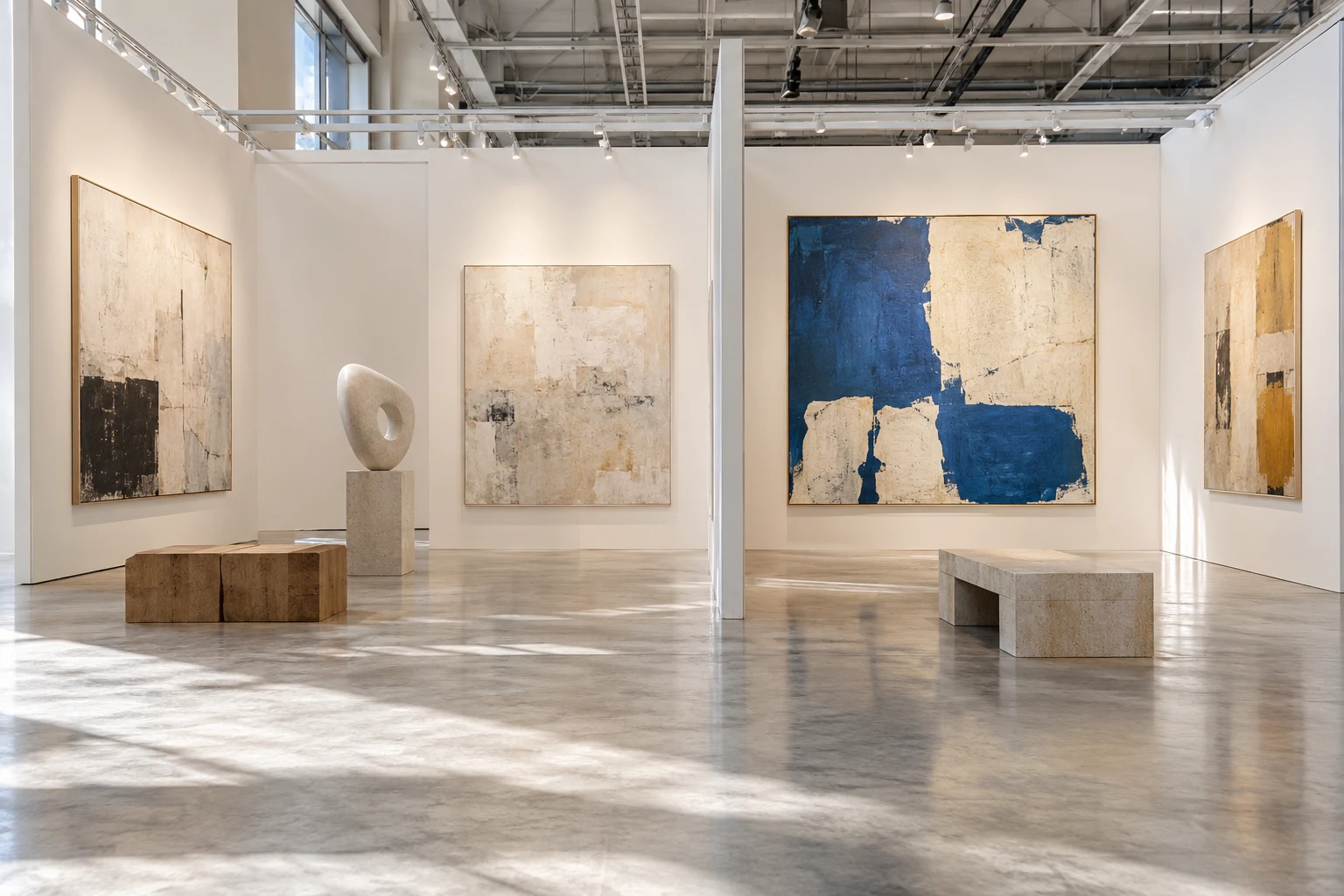
Compare a work on paper with a canvas by the same artist, or two artists’ uses of a similar colour. Ask how scale changes the tension and how the material changes your response. A comparison need not end with a winner; it can reveal what your attention is actually following.
Revisit authorised images or exhibition catalogues at home, treating the screen as preparation for another encounter. Surface, reflection and the experience of moving in front of a work deserve their own notes. “Compelling in a photograph” and “difficult to leave in person” are both useful observations, but they describe different experiences.
Follow an artist through time
After finding one compelling object, examine work from another period. Artist pages, museum records and catalogues can establish titles, dates and materials. A long exhibition history supplies context, but it does not perform the work of looking for you. Consider which questions persist across changes of scale or technique.
If dense early drawings lead to broad later colour fields, ask what connects them. A specific question usually produces a more useful conversation than demonstrating familiarity with a list of exhibitions. Nor must the explanation resolve everything: something still unsettled may become the reason to return.
Give the collection a loose sentence
A working theme can be modest: “empty spaces in cities” or “traces of everyday life after people leave.” It is more useful than a category as broad as contemporary art. Treat the sentence as a direction that can develop, allowing an unexpected work to make the theme more precise.
Look also at the things you already keep: a small travel print, a frequently opened photobook, an exhibition catalogue. They need not all be marketable artworks to be valuable evidence of taste. The repeated choices may reveal a visual interest that an ambitious collecting manifesto would otherwise obscure.
Imagine the conditions of living together
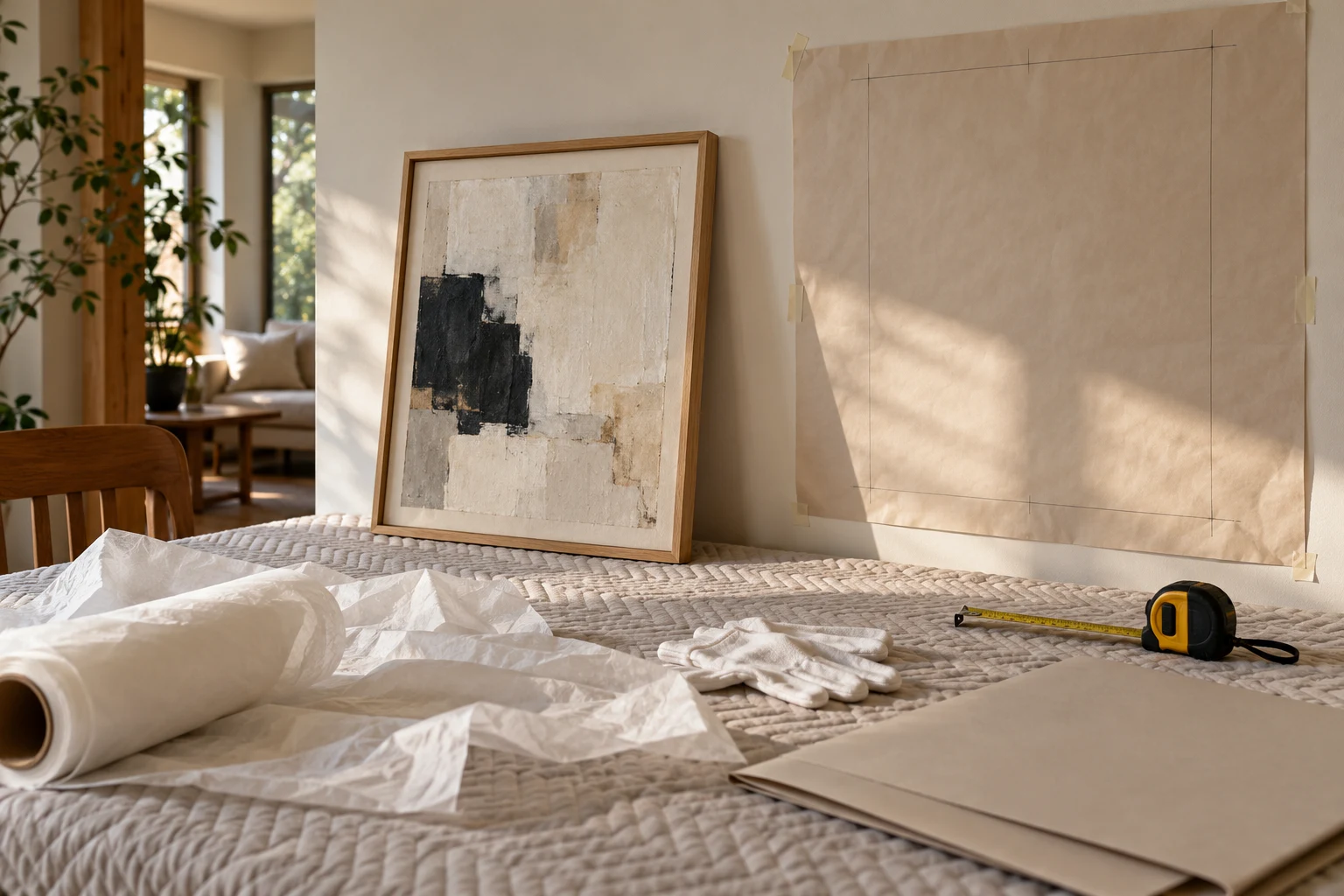
Measure the outer dimensions and consider where you will actually encounter the work: from the dining table, on entering a room, or across a passage. A paper template can make the scale tangible. Include changing daylight and possible future furniture arrangements in the conversation before commissioning a frame.
The Canadian Conservation Institute identifies direct sunlight, abrupt environmental changes and handling among risks to paintings, and advises that cleaning and repairs belong with a conservator.[2] Request medium-specific care guidance from the seller. That makes responsibility for the object part of choosing it, rather than an afterthought once it arrives.
Connect the story to its records
When a story concerns ownership, an exhibition or production, ask which record supports it. Responsible Art Market’s due-diligence guidance brings ownership history together with supporting documents.[3] A persuasive narrative and an identifiable record have different roles; retain the source of each statement rather than letting conversation become undocumented certainty.
One folder per work is a practical start: permitted photographs, the sales description, purchase documents, installation advice and written answers to questions. Keep your personal response separately. Good organisation does not certify authenticity, but it makes later questions about the object and its history much easier to pursue.
Include the year after the purchase
Separate the work’s price from possible framing, transport, installation, insurance and storage costs. Not every item applies to every acquisition; the point is to identify inclusions before fixing a comfortable limit. The margin remaining after payment can be more meaningful than the size of a negotiated discount.
Imagine owning the work for a long time, without depending on a quick resale. Waiting need not end the relationship: follow the next exhibition, revisit another work, or read a catalogue. Those activities build a collection’s understanding even when they add nothing to its inventory. This article offers no prediction of future prices.
Keep the before and after of an explanation
Write a brief response before reading the interpretation, then compare it with what you notice afterwards. A process description may reveal hesitation in a line that first seemed cold; an eloquent account may still leave you unmoved by the object. Both responses can show how explanation and direct experience meet.
If a companion disagrees, ask which part held their attention. One person may follow material, another rhythm. The opportunity to look again is useful in itself. You need not defend a preference through market reputation or adopt someone else’s enthusiasm to prove that you understood the work.
Match the purchase to your pace of looking
Learning that a work is available can abruptly change the pace of looking. Revisit the original reason it appealed, then examine budget, space and documentation. Comparing alternative purchases can help with priorities, but does not fully explain why this particular object remains worth your attention.
Keep a note of a deferred purchase too: size, missing information or the inability to care for it at present. When conditions change, that record explains the earlier decision. A notebook containing only acquisitions omits much of the learning; a work you studied and did not buy may shape the next choice.
Try a month of looking
As an editorial exercise, visit two different exhibitions in week one and note three works at each. In week two, follow one artist into another period. Revisit a work or consult its catalogue in week three, then identify what still remains vivid in week four. This is a flexible exercise, not a validated training programme.
Finish with three sentences: why you want to keep looking, which fact you still need, and what would stop a purchase now. They need not resolve neatly. An increasingly useful eye can articulate both attraction and hesitation, giving an eventual purchase a context that lasts longer than the excitement of choosing it.
Sources and editorial note
The cover is an AI-generated editorial illustration. It is not a documentary photograph of a particular place, product or person discussed in this article.
Sources checked on 1 November 2026. This article combines published primary sources with editorial examples; it does not report an on-site interview or authenticate, value or offer any particular artwork for sale.
[1] National Gallery of Art — Remembering the Vogels · View source: www.nga.gov
[2] Canadian Conservation Institute — Basic care: Paintings · View source: www.canada.ca
[3] Responsible Art Market — Art Transaction Due Diligence Toolkit · View source: www.responsibleartmarket.org