Sleep and recovery: a day that makes room for rest
Consider sleep time, the bedroom, evening plans, wearable records and signs worth discussing with a clinician. A useful night-time routine begins with the shape of the whole day.

Consider sleep time, the bedroom, evening plans, wearable records and signs worth discussing with a clinician. A useful night-time routine begins with the shape of the whole day.
A good night begins with available time
It is possible to shop carefully for a pillow while repeatedly postponing bedtime. Examine the opportunity for sleep alongside its quality. If work, travel, dinner and phone use leave only a short interval to lie down, a small bedroom improvement cannot be expected to resolve the entire schedule.
NHLBI gives 7–9 hours a night as a general adult recommendation.[1] This is a reference range, not a score that every person must reproduce identically each night. Consider age, health, daytime functioning and sleepiness, and distinguish time in bed from time actually asleep.
Put fixed commitments and the required waking time on the calendar, then see whether a realistic sleep interval fits. Reduce avoidable evening decisions where possible and record constraints you cannot control alone. Shift patterns and care responsibilities deserve recognition rather than being recast as failures of willpower.
Connect waking time with the daytime route
NHLBI recommends a consistent sleep-and-wake schedule, daytime activity and time outdoors.[2] Apply the general principle to the actual work pattern and health context. A person working nights cannot simply be given a daytime worker’s timetable and expected to adapt through discipline alone.
After waking, begin with the tasks needed for the day instead of immediately grading the night. Preparing clothes or a bag beforehand can make the morning less hurried. This is ordinary organisation, not a sleep treatment, but it clarifies which decisions can be removed from the evening.
Notice when sleepiness is strongest and describe its effect. A brief tired feeling after lunch differs from struggling to remain awake during work or driving. If long mornings in bed appear only on days off, consider weekday sleep opportunity and workload without forcing every bodily signal to match an ideal timetable.
Adjust the bedroom one sense at a time
Consider light, sound, temperature and bedding separately. CDC recommends a quiet, relaxing and cool bedroom.[3] Before buying a product, identify light from the street or devices, outside noise, and whether bedding feels too warm or uncomfortable. A single numerical temperature need not be comfortable for everyone.
For a hotel stay, ask about light control, pillow options and the room’s relationship to lifts or event spaces. Confirm what can be accommodated without assuming a specific allocation or perfect silence. Knowing what matters to you makes the request more useful than choosing solely from room photographs.
With a sleeping partner, discuss alarms, lighting and late screen use, and consider separate bedding or adjusted routines where helpful. Change one manageable condition, experience it, then reassess. Replacing everything at once makes it difficult to learn which change actually felt more comfortable.
Make the last hour lighter
If decisions continue until bedtime, the body may be in the bedroom while work carries on. Make a short list of what must finish and what can wait, including a time to review unfinished tasks. This is a way to reduce remembering demands, not an instruction to remove anxiety through determination.
NHLBI advises a quiet period before bed, attention to bright artificial light and caution with caffeine and alcohol.[2] Note when a caffeinated drink was taken, not just its name, and check unfamiliar beverages. Do not make alcohol-induced sleepiness the basis of a sleep plan; follow clinical guidance about medication and drinking.
The routine can be short: finish tomorrow’s preparation, lower the light and read a few comfortable pages. Check that scent or music also suits anyone sharing the room. On a late evening, keep the useful elements instead of completing a long ritual at the expense of available sleep time.
Consider what the day demanded
Recovery can refer to sleep, quiet rest, the space between exercise sessions or time away from work. Name which is needed. An evening after long sitting may feel different from one after extensive travel; the day’s demands and tomorrow’s commitments can inform a more appropriate choice.
Keep a few simple options available: a quiet room, a brief household task followed by stopping, or a comfortable conversation. Record what felt restful without treating that feeling as proof of medical improvement. Persistent fatigue that substantially disrupts life deserves discussion rather than an automatic lifestyle explanation.
Allow room to adjust an exercise plan and to rest. If sleep opportunity remains inadequate, review it before extending the day with stimulating drinks and more demanding activities. Ask whether leisure obtained by repeatedly removing sleep is serving the intended recovery, then aim for a pattern that can continue.
Use wearable records to support questions
Before interpreting a low sleep score as a verdict, ask what sensors and algorithm produced it, whether data were missing and which measures are estimates. Read the device’s intended-use information. Scores from different products should not automatically be assumed to represent the same scale.
Some devices have regulated sleep-apnoea risk features. The US FDA’s QZW classification describes risk assessment and notification, not standalone diagnosis or replacement of traditional diagnostic methods.[4] Neither “no wearable has a medical function” nor “one alert settles the diagnosis” is accurate. Authorisation and conditions in other jurisdictions need separate checking.
Organise a useful record alongside daytime sleepiness or observations from a sleeping partner for a clinical discussion. If morning scores create anxiety, reconsider the checking frequency and purpose. Do not alter medication or undertake extreme sleep restriction to meet an app-generated target.
Know when to seek assessment
Loud snoring, witnessed pauses in breathing, waking while gasping and marked daytime sleepiness are worth describing to a clinician. NHLBI identifies these as possible sleep-apnoea symptoms and notes that a sleep study may be needed.[5] Neither ordinary tiredness nor the absence of an app alert settles the cause.
If trouble falling or remaining asleep continues to affect daily life, seek care. NHLBI generally recommends cognitive behavioural therapy for insomnia, CBT-I, as the first treatment for long-term insomnia.[6] This is a structured clinical approach, not simply new bedding or a collection of generic sleep tips.
If you struggle to stay awake while driving or performing hazardous work, stop and arrange a safe alternative. CDC NIOSH describes involuntary microsleeps that may occur without awareness.[7] Report recurring sleepiness and fatigue in the consultation, while addressing the immediate safety of travel and work without waiting for a diagnosis.
Keep a brief diary and some room for variation
NHLBI suggests a one- to two-week diary before consultation, including sleep and waking times, naps, daytime sleepiness, caffeine, alcohol and exercise.[8] Approximate observations are useful; exact second-by-second recording is unnecessary, and unknown values should not be invented to make a complete-looking chart.
Observe the current pattern in the first week, then try one feasible routine adjustment in the second, such as finishing administrative tasks earlier. This editorial example is not an insomnia treatment programme or a promise of results. Significant or persistent symptoms should not wait until the diary is complete before care is sought.
Review which conditions can realistically continue, rather than chasing the highest score from one good night. A quiet room, a manageable timetable and appropriate clinical help matter in different proportions for different people. Leave space for ordinary variation so that preparing for rest does not become another source of pressure.
Sources and editorial note
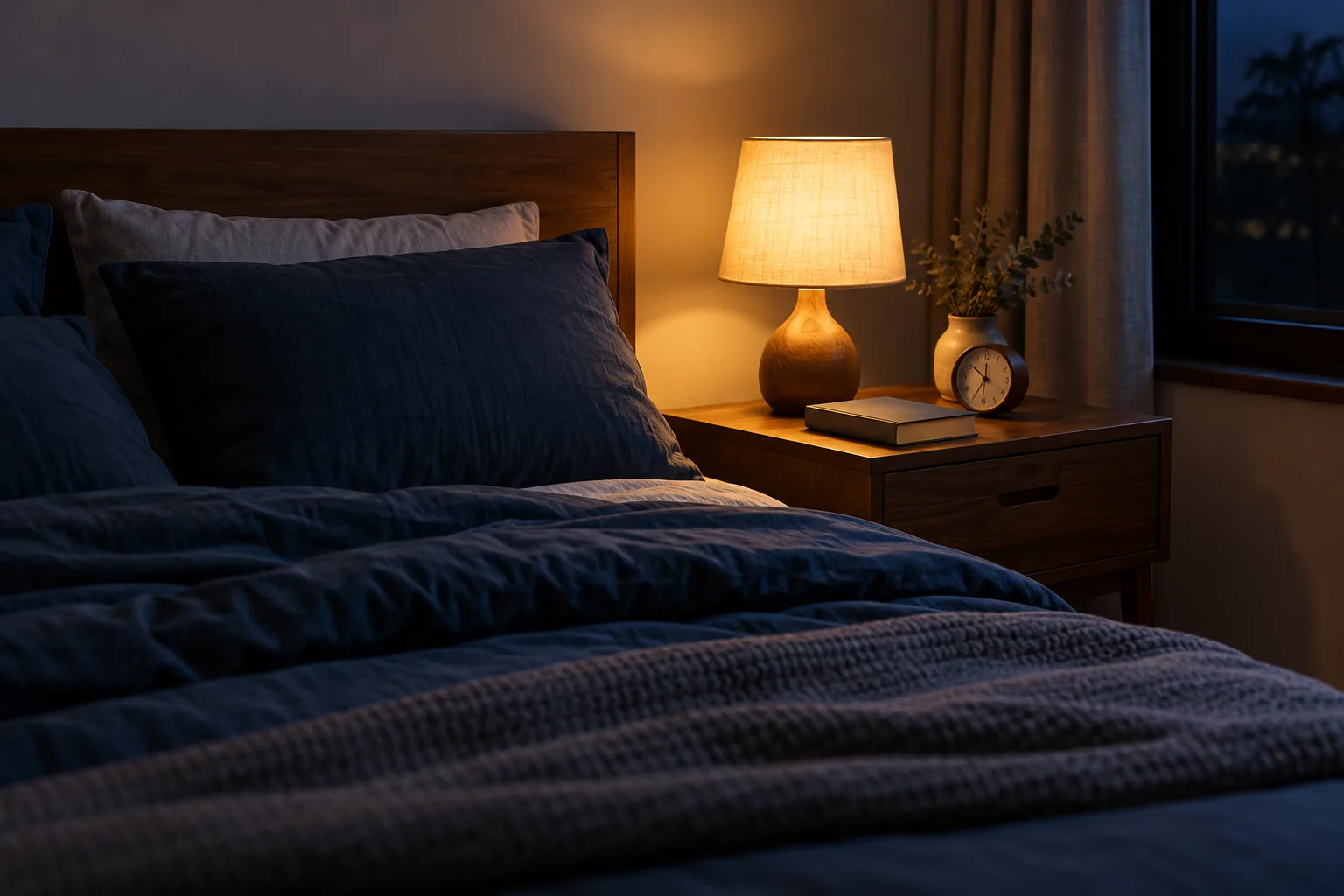
The cover is an AI-generated editorial illustration. It is not a documentary photograph of a particular place, product or person discussed in this article.
Sources checked on 1 November 2026. This article combines primary-source research with editorial planning examples. It does not report an on-site visit, a personal treatment or an independently commissioned medical review.
[1] NHLBI — How Much Sleep Is Enough? · View source: www.nhlbi.nih.gov
[2] NHLBI — Healthy Sleep Habits · View source: www.nhlbi.nih.gov
[3] CDC — About Sleep · View source: www.cdc.gov
[4] US FDA — Product Classification QZW · View source: www.accessdata.fda.gov
[5] NHLBI — Sleep Apnea Symptoms · View source: www.nhlbi.nih.gov
[6] NHLBI — Insomnia Treatment · View source: www.nhlbi.nih.gov
[7] CDC NIOSH — Microsleeps · View source: www.cdc.gov
[8] NHLBI — Insomnia Diagnosis · View source: www.nhlbi.nih.gov